EU battery passport compliance.
No consultants required.
PassportIQ manages your battery passports throughout their entire operational lifetime — not just at creation. Register your fleet, track state of health, log lifecycle events, connect to the EU Registry, and stay compliant as regulations evolve. No consultants, no six-month implementation.


EU battery passports are
genuinely complex to get right.
The regulation touches every stage of the battery lifecycle — from sourcing to end-of-life — and requires a precise split between model-level design data and unit-level manufacturing data.
The regulation is genuinely complex
Annex XIII mandates data across carbon footprint, recycled content, hazardous substances, SoH, and dismantling — split between design-level and unit-level records. Getting the structure wrong fails compliance.
The deadline is closer than it looks
The EU DPP Registry goes live July 19, 2026. Passports must be registered before batteries can be placed on the market. February 2027 is the hard cutoff — leaving it to late 2026 is a serious risk.
Enterprise tools are overkill
The platforms targeting large OEMs start at €50,000 per year and take months to implement. Most battery importers and smaller manufacturers need something that actually fits their size and budget.
Compliance doesn't end at registration
State of health changes. Batteries are repaired, transferred, and repurposed. The passport must stay accurate over time — a one-time filing tool leaves you non-compliant the moment anything changes.
PassportIQ is the straightforward alternative.
Register your fleet, track compliance, connect to the EU Registry — without the enterprise price tag or the six-month wait.
Everything you need.
Nothing you don't.
Built against Regulation (EU) 2023/1542 and the June 2026 DPP Registry Implementing Regulation draft. No bloat, no six-month onboarding — just the features that get you compliant and keep you that way.
Model & unit data split
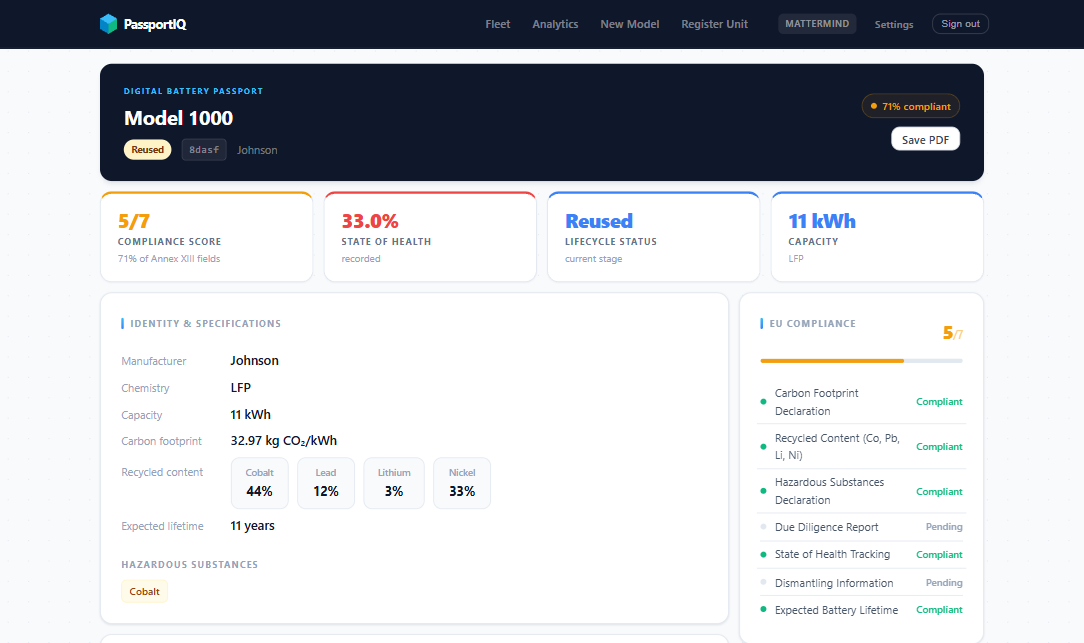
Correctly separates design-level model data from unit-level manufacturing data — carbon footprint, recycled content, and manufacturing plant per physical unit; hazardous substances and dismantling info per model.
CSV bulk import
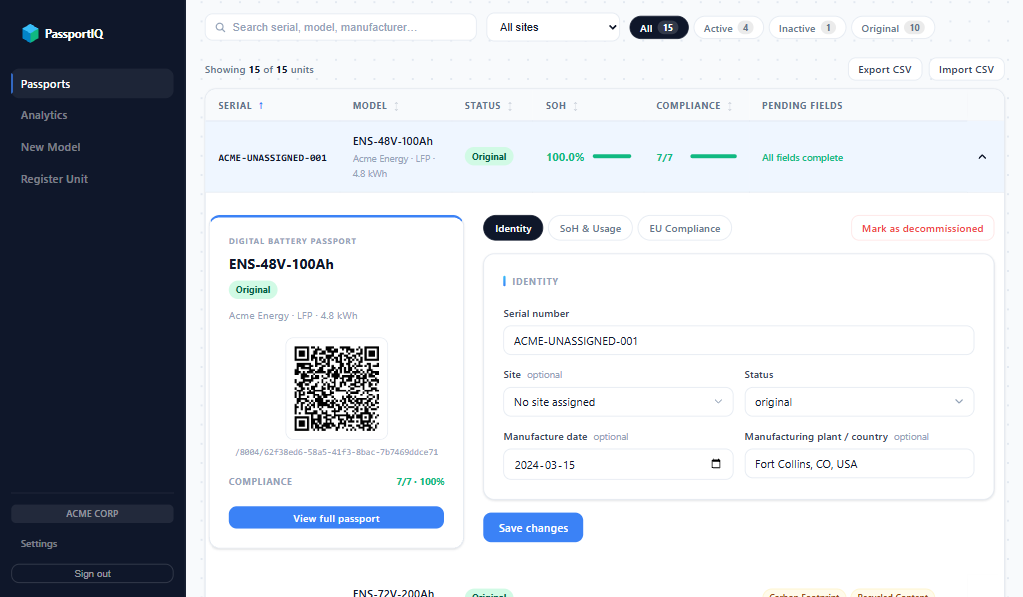
Onboard an entire fleet from a spreadsheet. Upload a CSV and every row is validated before anything is saved — missing required fields and duplicate serial numbers are flagged, and battery models are created automatically from the data. Register hundreds of units in one pass instead of one form at a time.
GS1 Digital Link QR codes
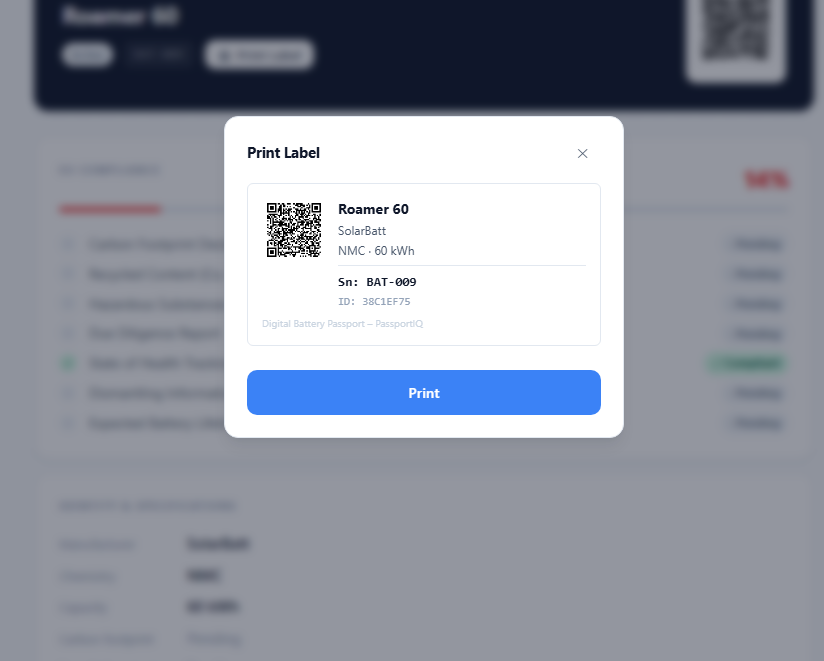
QR codes encode standardized GS1 Digital Link URLs (/8004/{unit_id}) that resolve correctly against the EU registry from day one. Print now, stay valid post-February 2027. QR codes never return a broken link — even in archive mode.
Passport continuity guarantee
Batteries outlive software subscriptions. Active subscribers get full passport data; after cancellation, a 30-day grace period preserves full access. Archive Hosting options keep full compliance data live for the battery's entire operational lifetime — no dashboard needed.
Live compliance scoring
Each unit gets a real-time compliance score (e.g. 5/7) against all seven Annex XIII fields. Missing fields are flagged by name so you know exactly what to fill in before the deadline.
Tiered access layers
Public, Industry (legitimate interest), and Authority tiers built in from day one — matching Annex XIII Sections 1–4. Recyclers see SoH and dismantling. Authorities see technical records.
Fleet dashboard
See every battery unit at a glance — compliance scores, SoH readings, status filters, and incomplete field flags. Spot what needs attention before an auditor does. One click to open any passport.
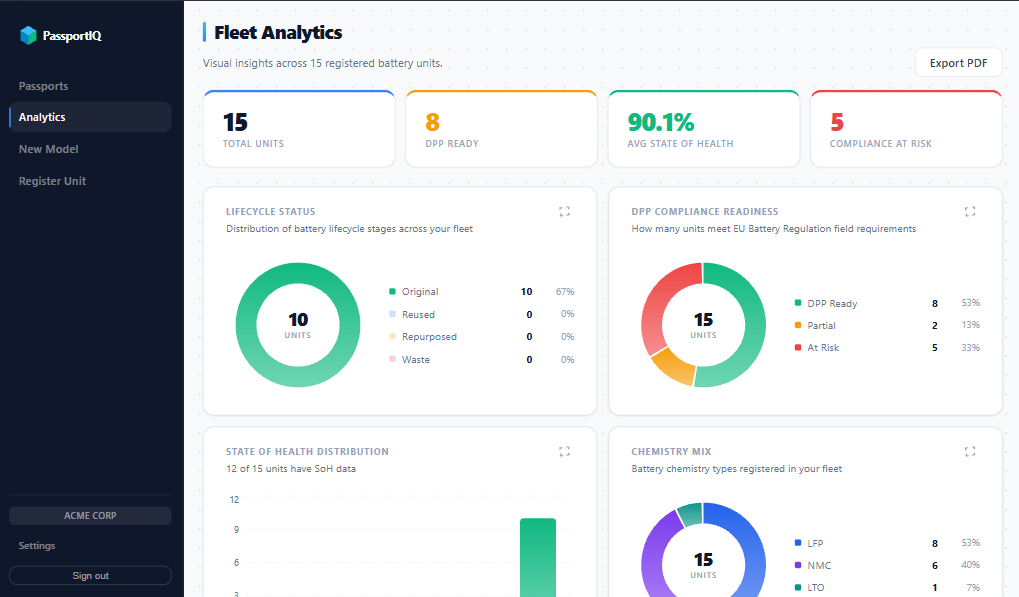
Fleet analytics
Interactive charts across your entire fleet — SoH distribution by health band, DPP compliance readiness, chemistry mix, and compliance trends over time. Drill into any chart to filter and inspect individual units.
A platform built for
real compliance work.
From fleet management to the scanned passport page — every screen is designed to handle what the regulation actually asks for.
Passport compliance in
four steps.
Register your battery model
Enter design-level data once — chemistry, capacity, hazardous substances, expected lifetime, and dismantling instructions. Every unit of that design inherits it automatically.
Register individual units
Add each physical battery by serial number — or bulk-import your whole fleet from a CSV in one pass. Record the manufacturing plant, manufacture date, carbon footprint, and recycled content per unit.
Print & attach the QR code
Print the label and attach it to the battery. Anyone — recycler, customs, regulator — can scan it and see the correct data for their access level. No app required.
Stay compliant as things change
Update state of health, record repairs, and log status changes as batteries age. The passport stays current automatically — and connects to the EU Registry when it goes live in July 2026.
Built against the
actual regulation text.
Every feature maps to a specific article or annex in Regulation (EU) 2023/1542. Nothing is inferred — it is either covered, or it is on the roadmap.
Declaration per battery, per manufacturing plant. Unit-level, varies by run.
Co, Pb, Li, Ni percentages per unit per procurement batch.
SoH tracking for stationary BESS, LMT, and EV batteries with BMS.
Supply chain due diligence URL at model level (mandatory August 2028).
All publicly accessible model and unit fields.
Dismantling, detailed composition, safety measures (legitimate interest).
SoH, status, cycle count, accident history (legitimate interest).
Test results, model/unit IDs, timestamps (notified bodies).
EN 18219/18220 compliant data carrier using AI 8004 (GIAI).
eIDAS-based identity verification required before any registry registration. Legal persons: qualified electronic seal via QTSP. Sole traders: qualified electronic signature. Valid for 3 years.
API submission to the EU Central Registry — automatic validation of semantic conformity, granularity level, and eIDAS seal. Unique registration identifier issued on success. Integration built; activates when the registry goes live (July 2026).
Organization-scoped passports with authorization agreements.
A–E performance class label derived from lifecycle carbon footprint (mandatory for EV batteries from July 2027).
Formal legitimate interest authentication (after Q4 2026 Implementing Act).
Founding partner
program now open.
We're working directly with a small number of battery manufacturers and importers ahead of the February 2027 mandate. Each founding partner gets full platform access, white-glove onboarding, and direct input on the product roadmap.
Hands-on onboarding
We work with you directly to register your battery models and units. Not a help doc — a person.
Priority EU Registry connection
Founding partners are first in line when the EU Battery Passport Registry goes live. Your passports connect automatically.
Input on the roadmap
Tell us what you need. Founding partners shape the feature set — compliance fields, reporting formats, integrations.
Spots are limited. Priority given to manufacturers and importers with active EU market presence.
Have questions?
We're here.
Whether you're evaluating compliance options, have questions about the regulation, or need help getting your fleet set up — send us a message and we'll respond within one business day.